
ISR tactical parachute system
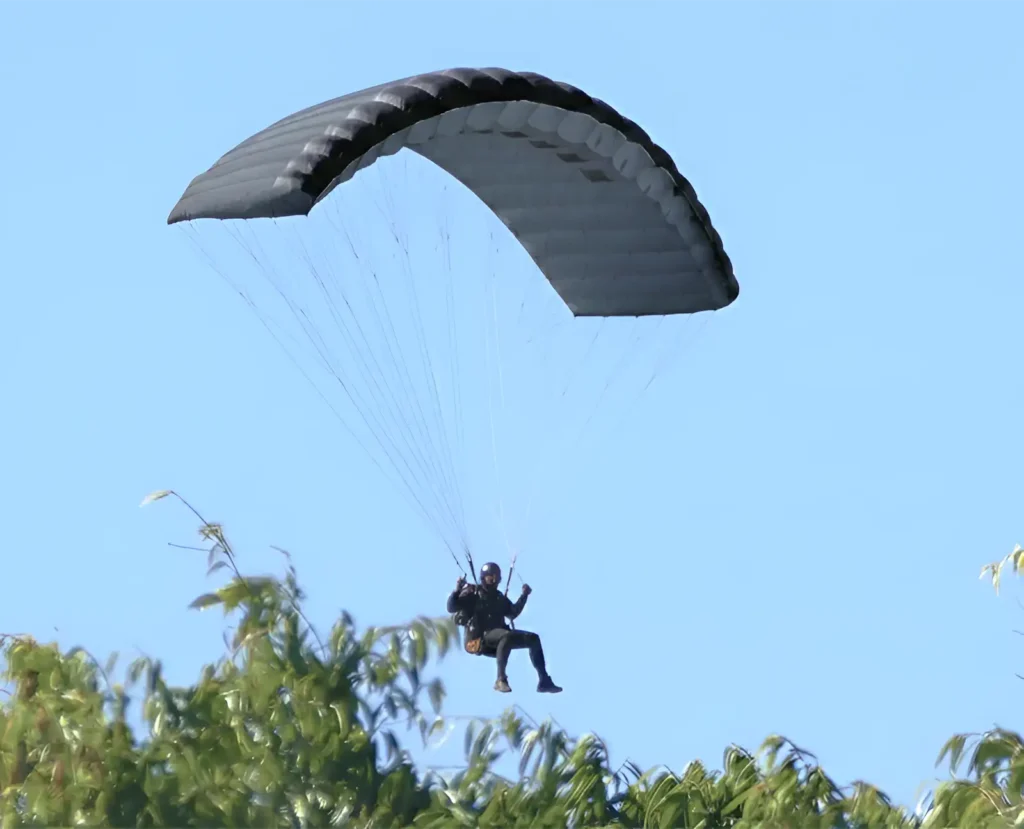
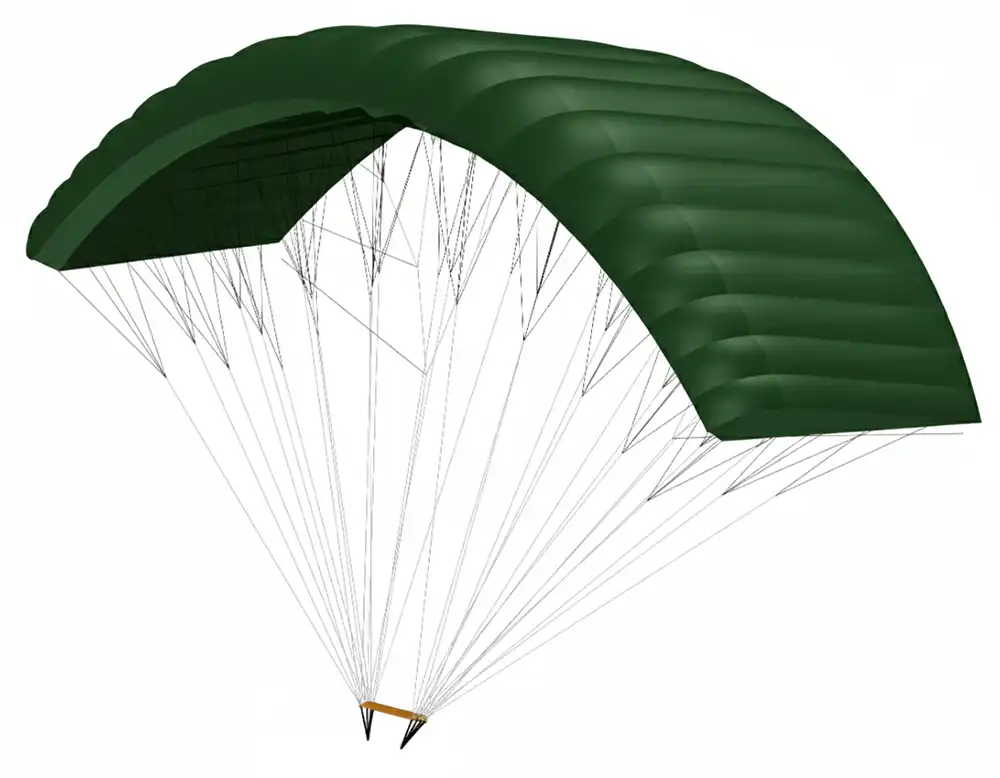
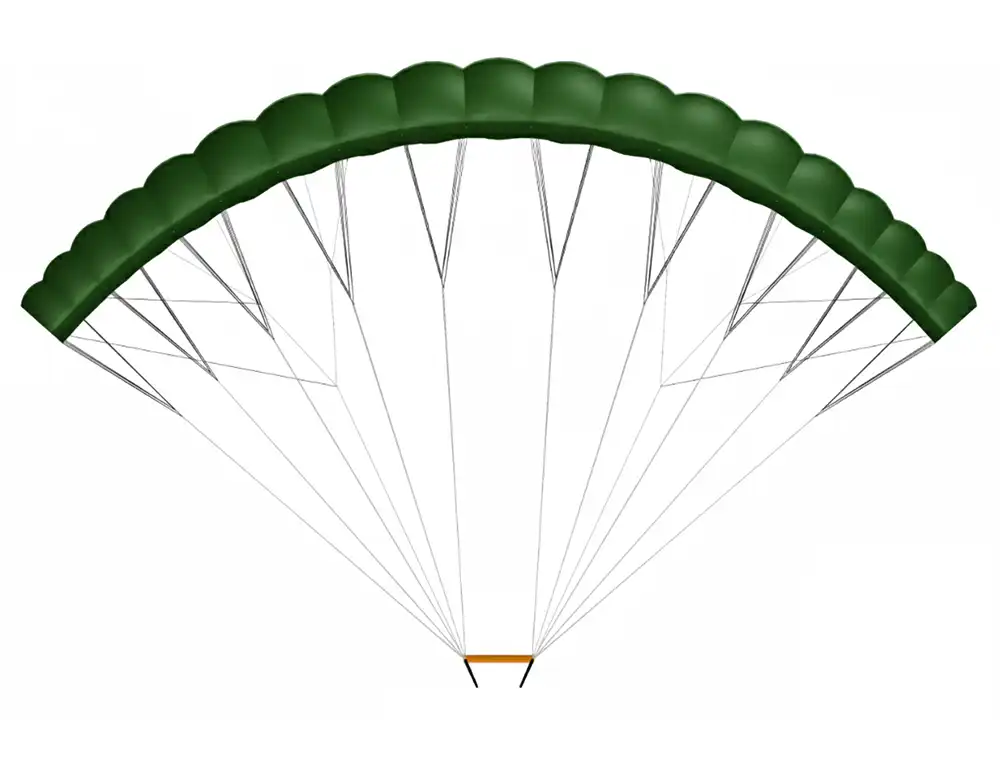
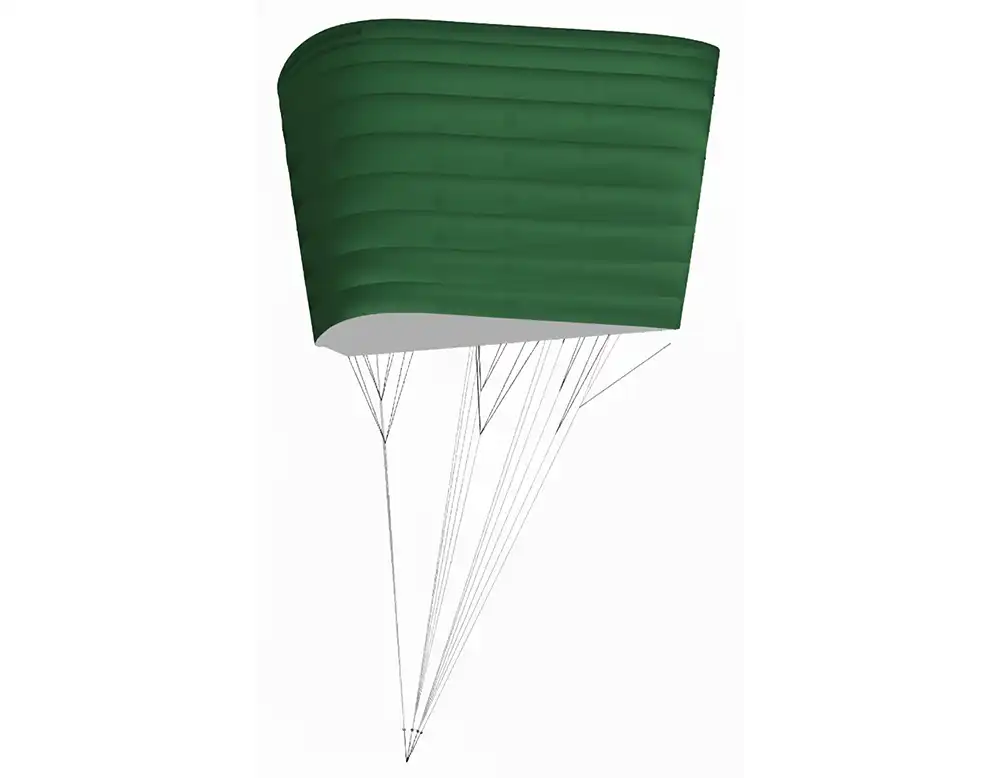
A fully specified tactical ram-air canopy: elliptical 19-cell planform, glide ratio 1:4.5, ultra-light fabric at 24 g/m².
Canopy and material
Advanced. Compact. Mission-ready. The ISR tactical parachute system is built for operators, engineered for performance and trusted worldwide.
The elliptical 19-cell planform delivers glide, stability and flare. The glide ratio of 1:4.5 provides extended range and improved manoeuvring. The fabric weighs 0.7 oz, or 24 g/m², keeping weight and pack volume low; lines are Dyneema HMPE with high strength, low stretch and long-term durability. The leading-edge material is zero porosity, which improves airflow and increases glide performance.
Controlled deployment
Three components govern opening behaviour:
- An adjustable-drag slider controls opening speed, reduces shock and adapts to different mission profiles.
- One-directional inflation valves on the bottom skin improve inflation time, inflation accuracy and dependability.
- A reinforced internal structure maintains canopy integrity during high-load or high-speed openings.
Handling
Control runs through a tip-steering system inspired by high-performance paramotor wings: the initial input acts at the tips and gives agile, precise heading control, while progressive centre engagement delivers a strong landing flare. A B-stall manoeuvre allows controlled vertical descent for confined-area approaches or rapid altitude loss.
Operational advantages
In the field, three properties count:
- Low pack volume for compact tactical loadouts.
- Lightweight construction ideal for manned and unmanned platforms.
- High-efficiency aerodynamic design optimised for maximum mission capability.
Performance by size & payload
The range spans ISR75 to ISR1000, with certified maximum exit weights from 55 kg to 1,000 kg. For each size the table lists expert and novice exit weights, flat aspect ratio, span, centre chord, peak force, pack volume and canopy weight.
| Product Code | Sq. Ft. (size) | Exit Weight Expert (lbs.) | Exit Weight Expert (kg) | Exit Weight Novice (lbs.) | Exit Weight Novice (kg) | Flat AR | Projected Span [m] | Projected Span [ft] | Center Chord [m] | Center Chord [ft] | Peak Force [lbf] | Volume cu. in. | Volume cu. in. pressure packed | Canopy weight [Kg] | Canopy weight [lbs] |
|---|---|---|---|---|---|---|---|---|---|---|---|---|---|---|---|
| ISR75 | 75 | 120 | 55 | N/A | N/A | 2.9 | 4.04 | 13.2 | 1.65 | 5.4 | 3465 | 305.1 | 274.6 | 1.2 | 2.6 |
| ISR95 | 95 | 149 | 68 | N/A | N/A | 2.9 | 4.54 | 14.9 | 1.85 | 6.1 | 3465 | 386.5 | 347.8 | 1.5 | 3.3 |
| ISR115 | 115 | 171 | 78 | N/A | N/A | 2.9 | 5 | 16.4 | 2.04 | 6.7 | 3465 | 467.9 | 421.1 | 1.8 | 4 |
| ISR125 | 125 | 188 | 85 | 100 | 45 | 2.9 | 5.21 | 17.1 | 2.12 | 7 | 3465 | 508.5 | 457.7 | 2 | 4.3 |
| ISR150 | 150 | 225 | 102 | 125 | 57 | 2.9 | 5.71 | 18.7 | 2.33 | 7.6 | 3465 | 610.2 | 549.2 | 2.4 | 5.2 |
| ISR160 | 160 | 240 | 109 | 135 | 61 | 2.9 | 5.9 | 19.3 | 2.4 | 7.9 | 3465 | 650.9 | 585.8 | 2.5 | 5.5 |
| ISR180 | 180 | 254 | 115 | 155 | 70 | 2.9 | 6.25 | 20.5 | 2.55 | 8.4 | 3465 | 732.3 | 659.1 | 2.8 | 6.2 |
| ISR200 | 200 | 254 | 115 | 165 | 75 | 2.9 | 6.59 | 21.6 | 2.69 | 8.8 | 3465 | 813.7 | 732.3 | 3.1 | 6.9 |
| ISR225 | 225 | 254 | 115 | 185 | 84 | 2.9 | 6.99 | 22.9 | 2.85 | 9.4 | 3465 | 915.4 | 823.8 | 3.5 | 7.8 |
| ISR245 | 245 | 330 | 150 | 200 | 91 | 2.9 | 7.3 | 23.9 | 2.97 | 9.8 | 3800 | 996.7 | 897.1 | 3.8 | 8.4 |
| ISR265 | 265 | 330 | 150 | 225 | 100 | 2.9 | 7.59 | 24.9 | 3.09 | 10.2 | 3800 | 1078.1 | 970.3 | 4.2 | 9.1 |
| ISR300 | 300 | 330 | 150 | 220 | 100 | 2.9 | 8.07 | 26.5 | 3.29 | 10.8 | 3800 | 1220.5 | 1098.4 | 4.7 | 10.3 |
| ISR330 | 330 | 726 | 330 | 242 | 110 | 2.9 | 8.47 | 27.8 | 3.45 | 11.3 | 8712 | 1342.5 | 1208.3 | 5.2 | 11.4 |
| ISR360 | 360 | 792 | 360 | 264 | 120 | 2.9 | 8.84 | 29 | 3.61 | 11.8 | 9504 | 1464.6 | 1318.1 | 5.6 | 12.4 |
| ISR400 | 400 | 880 | 400 | 293 | 133 | 2.9 | 9.32 | 30.6 | 3.8 | 12.5 | 9680 | 1627.3 | 1464.6 | 6.3 | 13.8 |
| ISR500 | 500 | 1100 | 500 | 366 | 167 | 2.9 | 10.42 | 34.2 | 4.25 | 13.9 | 9900 | 2166.4 | 1678.2 | 6.8 | 14.9 |
| ISR1000 | 1000 | 2200 | 1000 | 733 | 333 | 2.9 | 14.74 | 48.4 | 6.01 | 19.7 | 15400 | 4332.7 | 3356.3 | 13.5 | 29.7 |
Deployment speed and staged deceleration
The maximum deployment speed always depends on the deployment altitude, payload weight and the allowable opening shock that the payload can withstand. For the maximum payload shown in the table, the recommended maximum deployment speed is 65 metres per second. The optimal deployment speed is approximately 40 metres per second.
For deployment speeds above 65 metres per second, a multi-stage deceleration system is required. A drogue chute is first used to slow the payload to a lower speed. The system may then transition directly to the main ram-air parachute, or use a secondary drogue chute for additional deceleration before main-canopy deployment. This staged process continues until the payload reaches a safe speed range that allows the ram-air parachute to deploy properly and reliably.
Adjusting opening time
The opening time of a ram-air parachute can be adjusted through several design and deployment parameters, including slider size and shape, slider control methods, bottom-surface valves and packing technique. These factors influence how quickly the canopy inflates and pressurises. By selecting the right combination, the system can be optimised for reduced opening shock, controlled inflation or faster deployment, depending on payload and mission needs.
Opening above 70 m/s: reefed deployment
Opening a ram-air parachute at speeds above 70 metres per second is possible, but it generally requires a reefed deployment configuration.
In this approach, several centre cells of the parachute are temporarily closed or restrained during the initial stage of deployment. This reduces the effective surface area and initial span of the canopy, and also lowers the effective aspect ratio during first inflation. As a result, the parachute opens in a smaller and more controlled configuration, helping to reduce opening shock at higher speeds.
After the initial deceleration phase, the restrained cells can be released based on time, altitude or another deployment trigger, allowing the canopy to expand to its full span and full surface area for additional deceleration and normal gliding performance.
This can be implemented as a single reefing stage or multiple reefing stages, depending on the mission profile, the initial deployment speed and the allowable loads on the payload and parachute system.
Reducing pack volume
Pack volume can often be reduced in several ways, depending on the mission requirements and deployment method.
The most direct approach is packing under pressure, which can significantly reduce volume. However, tighter packing may affect deployment time and usually requires an active deployment or extraction mechanism.
Additional methods include lighter fabrics, lighter line materials and optimised low-bulk construction techniques. These approaches can reduce both weight and pack volume while preserving the required aerodynamic and structural performance.
This is one of the manufacturer’s core strengths. Drawing on experience from the paragliding and hike-and-fly market, where low weight and compact pack volume are critical, it has experience designing and manufacturing parachute systems with reduced bulk and lower overall mass.
Any volume-reduction approach must be developed together with the customer, based on the full mission profile, allowable loads, deployment conditions and maximum structural demands expected during operation.
Autonomous navigation and guided missions
The ISR parachute is highly manoeuvrable, making it well suited for autonomous navigation and guided missions.
It can achieve a glide ratio of up to 4.5:1 and can also transition to a much steeper descent profile using a B-stall mechanism. This helps adjust the flight path more precisely and improve landing accuracy near the target point.
The manufacturer has extensive experience in autonomous parachute systems and guided aerial delivery, and can apply this expertise to projects requiring precision navigation, controlled descent and accurate target landing.
- System family
- Ram-air parachutesUltralight low volume solutions
- Platforms
- H.A.H.O. platformsH.A.L.O. platformsJPADSFixed-wing UAV
Technical data per manufacturer documentation from APCO Aviation Ltd , as of 2026-07-30.