
Cargo parachutes
Cargo parachutes deliver equipment, supplies and sensitive payloads to the ground safely and accurately.

Two base architectures
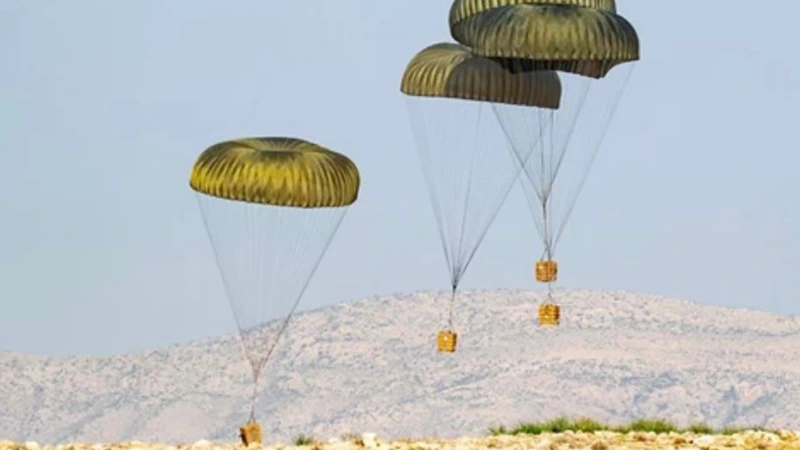
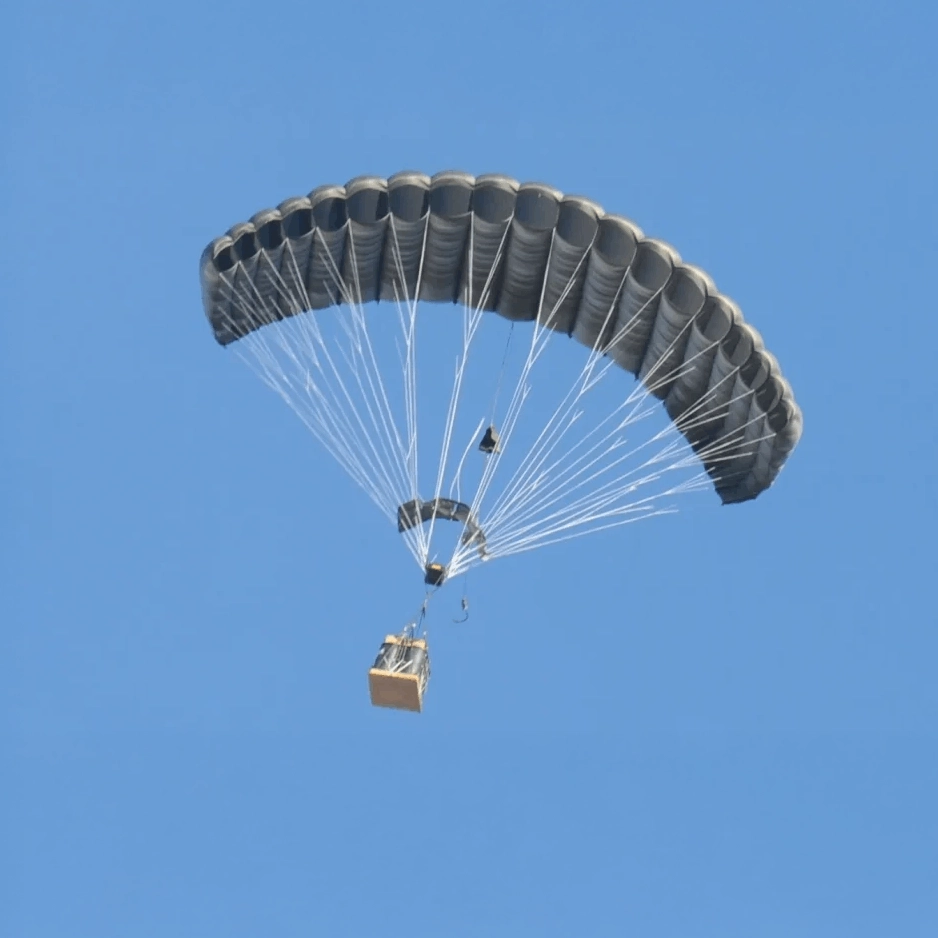
Two airdrop systems are common in defence and security logistics. The parachute cluster is a cost-effective solution that uses multiple smaller, readily available canopies; descent rates are finely tuned for various payloads by adjusting their number. The single large parachute is either a robust large canopy for very high payloads or a steerable system — parasail or ram-air — where the landing point matters.
In advanced systems like GPADS (Guided Precision Aerial Delivery Systems), steerable ram-air parachutes enable highly accurate drops in challenging environments.
The case for a single canopy
Three advantages over a cluster:
- Precision delivery: high-end cargo such as rocket boosters can be delivered by a single ram-air parafoil, precisely, softly and safely.
- Greater descent stability: without canopy-to-canopy interference the descent path is smoother and oscillates less.
- Lower complexity and cost: fabrication, packing and recovery are simpler with one canopy, while clusters need additional rigging and can be more expensive and time-consuming to manage.
Why clusters still matter
Clusters offer redundancy — if one canopy fails, the others compensate — load flexibility through canopy count, and quick inflation, which helps with heavy payloads. Their drawback is lead-lag: canopies inflate unevenly, causing uneven load distribution and potential performance issues.

Lightweight vs. heavy-duty solutions
While single large parachutes offer clear advantages, lightweight, low-bulk solutions enable more portable systems. However, they reduce the operational envelope — especially during high-speed drops that risk exceeding material limits. Decelerating drogue chutes or opening sliders help mitigate those risks without sacrificing performance.
- Platforms
- Cargo delivery · non-guidedJPADSH.A.L.O. platforms
- Environments
- Rough terrainAmphibious recovery
Technical data per manufacturer documentation from APCO Aviation Ltd , as of 2026-07-30.