
Self-inflatable airbag for a 75 kg UAV
A self-inflatable airbag for a 75 kg UAV fills a very large volume in the shortest possible time – synchronised with parachute descent, with no compressed gas or pump.
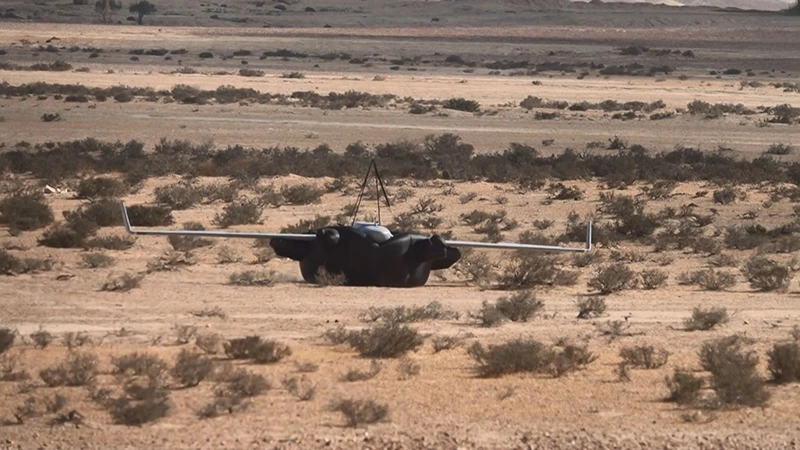
The challenge
Designing a reliable recovery system for UAVs requires ensuring safe landings with minimal impact forces. For a 75-kilogram UAV, the greatest challenge was inflating a very large airbag volume in the shortest possible time. The inflation process needed to perfectly align with the descent phase after parachute deployment – any delay would compromise protection at impact. Meeting this requirement demanded a lightweight, compact and ultra-fast deployment solution.
Proven self-inflation concept
APCO adapted technology from paragliding harness airbags, which have demonstrated reliability for decades. These systems are self-inflating, drawing air directly from ambient airflow and eliminating the need for heavy compressed-gas cylinders or pumps.
Internal mast with ducted fin
The UAV airbag incorporates an internal mast that inflates almost instantly due to its low volume. This mast includes a ducted fin that initiates airflow, creating a stable pathway for rapid inflation.
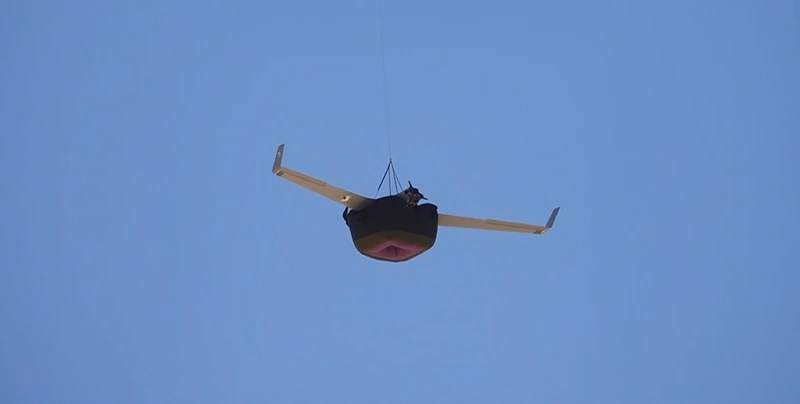
Ram-air assisted inflation
Once the mast is pressurized, it directs airflow into a forward-facing ram-air intake. As the UAV descends under parachute, the relative airflow rams into this intake, rapidly expanding the full-size airbag. This dual-phase sequence – ducted fin plus ram-air intake – delivers complete inflation significantly faster than conventional systems.
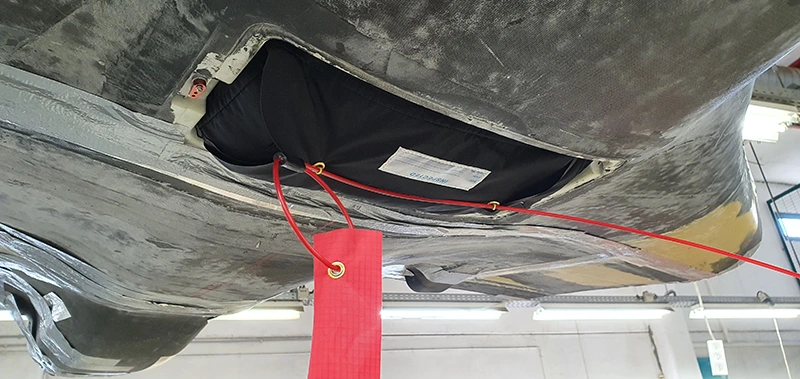
Results
- Fast deployment: inflation is synchronized with the UAV’s parachute descent profile.
- Lightweight and compact: requires no heavy components, minimizing battery and payload burden.
- Proven reliability: built on decades of paragliding airbag expertise, validated in thousands of impact events.
- Controlled deflation: engineered valves release air at touchdown, preventing damage and absorbing energy for softer landings.
Testing and validation
Extensive drop trials and real UAV recovery tests confirmed the system’s inflation speed, durability and impact-mitigation capability. Acceleration and force measurements were used to refine the optimal outlet size and configuration. Results consistently demonstrated safe landings, protecting sensitive avionics and structural components while ensuring mission-ready recovery.
Technical data per manufacturer documentation from APCO Aviation Ltd , as of 2026-09-22.