
Soft three-ring release mechanism
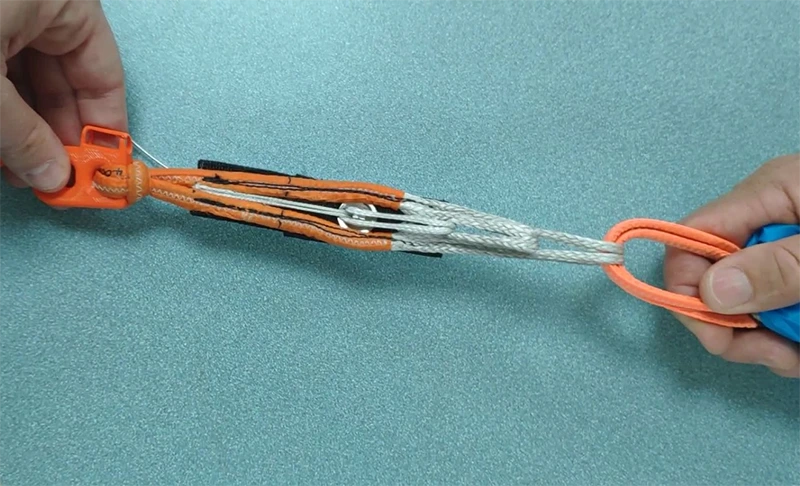
A fully textile three-ring release mechanism gives ultra-lightweight, damage-free separation for UAVs and parachutes – and releases only when manually activated.
The challenge
The customer required a super lightweight release solution for UAV recovery. Traditional metal three-ring systems posed two critical issues:
The challenge was to design a fully textile release mechanism that avoided these risks while remaining reliable, serviceable and simple to integrate.
- Damage risk: in the event of rebound, hard metal hardware could strike and damage the UAV’s carbon fiber body.
- Unwanted release: previous experiences with automatically engaging/releasing systems caused premature separation before touchdown, resulting in damage and mission failure.
The solution
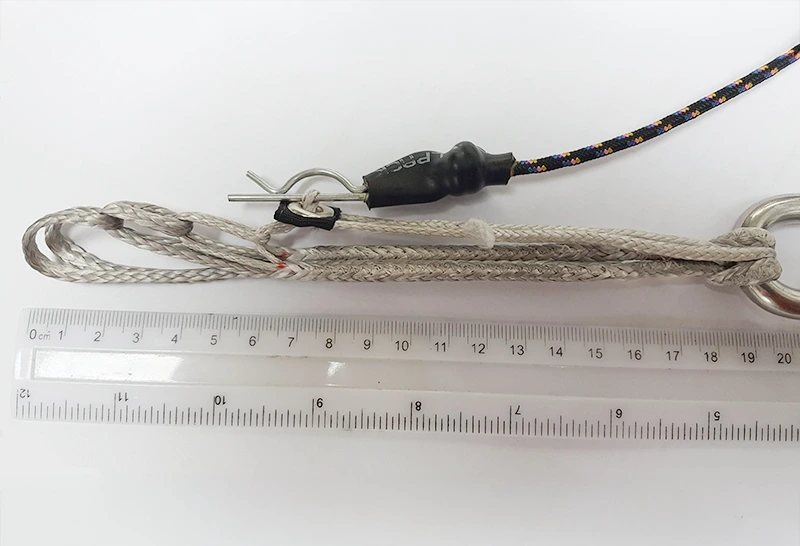
APCO developed a completely soft three-ring release mechanism, manufactured from the same high-strength webbing and textile materials as the parachute system itself. This ensured seamless integration, equal service life and no changes required in handling or storage practices.
Ultra-lightweight, damage-free design
- Entirely textile-based – no metal hardware.
- Prevents any damage in the event of rebound against the UAV fuselage.
- Extremely strong and compact, maintaining full deployment safety.
Controlled, manual release
- Designed for active engagement/activation only – preventing any accidental or premature release.
- The customer gains full control of parachute detachment timing.
- Optimized specifically for ground-touchdown separation scenarios.
Mission-ready advantages
- Withstands extreme parachute opening shock without failure.
- Serviceable within the same cycles as the parachute canopy.
- Customized to UAV recovery missions, cargo drops and defense applications.
Results
- Safe for UAVs: protects carbon fiber fuselages from impact damage.
- Zero accidental openings: only releases when manually activated.
- Lightweight advantage: eliminates heavy metal components while retaining strength.
- Full lifecycle integration: matches parachute service intervals and storage protocols.
Testing and validation
The soft three-ring release mechanism has been tested under:
Testing confirms that the soft release mechanism provides maximum mission safety, eliminating the disadvantages of traditional metal hardware in UAV applications.
- Extreme opening shocks – proven strength with no accidental release.
- Full mission cycles – validating reliability in UAV recovery operations.
- Environmental exposure – resistant to dust, sand, saltwater and high/low temperatures.
Technical data per manufacturer documentation from APCO Aviation Ltd , as of 2026-09-22.