
Paragliding and parachute cloth
Weight, porosity and elongation decide what paragliding and parachute cloth delivers and how long it keeps that performance over the lifespan of the wing.
Why the cloth matters
Published 21 August 2025, by Anatoly Cohn.
Since the birth of paragliding, the cloth has always been a major issue in paraglider design and manufacture. Paragliders are made from cloth and will probably continue to be for a long while. The cloth used by the industry is widely referred to as paragliding ripstop material – usually nylon with the typical ripstop square pattern.
Manufacturers sometimes like to present the issue as very complicated high-tech, and heated debates tend to create confusion. In the end it is a simple matter, easy to understand once the smoke is cleared. Several parameters are required from the cloth to be worthy of paragliding manufacture:
- Weight and strength.
- Porosity and coating.
- Elongation / elasticity.
1. Weight and strength
Everybody wants their wings light, especially lighter than their neighbours’. Obviously the lighter the cloth, the lighter the wing, and the general belief is that this is good: less volume, less bulk, less weight, more passive safety.
Practically all paragliders are made from cloth of similar construction, woven from the same nylon filament: 30 Denier high-tenacity nylon, known as Nylon 6.6. The Denier figure designates the weight of the filament for a fixed length – the lower the Denier number, the lighter, thinner and weaker the thread.
The cloth is woven in the typical ripstop pattern. It is generally believed that ripstop construction is needed to prevent runs (small tears), but this is not necessarily the case: there is no problem making gliders from plain weave cloth, and it will even have some advantages.
As a first parameter, the weight of the cloth depends on how tight the weave is. The cloth can be imagined as a net: built very tightly, with each filament placed side by side with the next, or as a loose net with big holes.
Thread count: lighter, cheaper, weaker
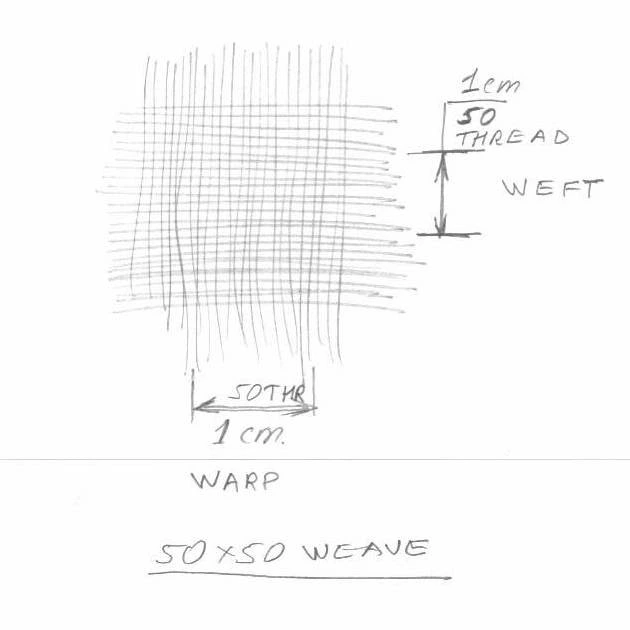
The industry reference is that good quality cloth should have at least what is called 100T count, meaning 50 threads weft and 50 threads warp constructed tightly per square centimetre of cloth, or more threads.
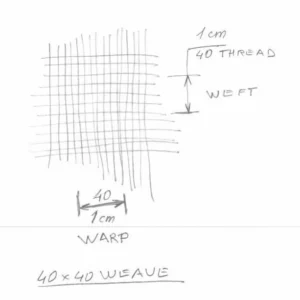
- Reducing the count to a 40 × 40 thread construction per centimetre (usually referred to as ends and picks) makes the cloth lighter by 20%.
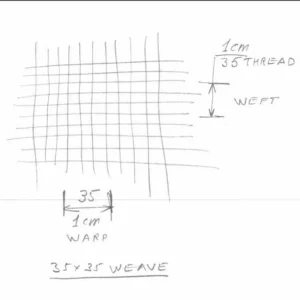
- Some manufacturers go further and reduce the count to 35 × 35.
- The lower the count, the lighter the cloth and the cheaper it is to produce: less filament, faster weaving.
- The side effect: the cloth will also be weaker, and ensuring its air permeability will be a more difficult task.
What thread count says about strength and ageing
Anyone buying a wing made from lighter cloth should be aware that its tensile strength and ageing deterioration are in direct correlation to the thread count. The claim that a cloth is lighter but stronger is, in the author’s view, practically never true – except for the price tag.
The exception is cloth made from an even lower Denier number: 20 Denier Nylon 6.6 exists and was recently developed, but it is practically not used for mass-produced standard paragliding wings.
2. Porosity and coating
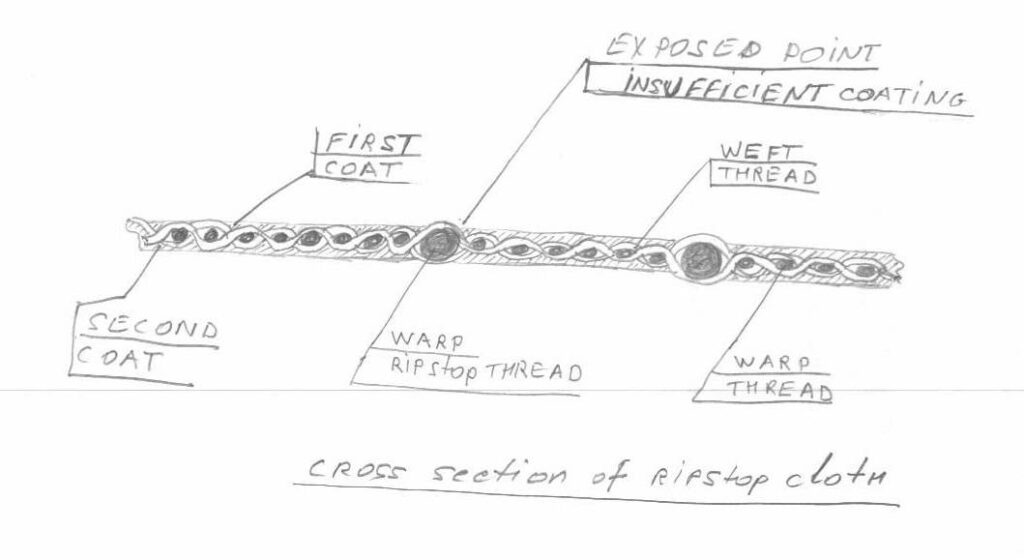
Porosity, or air permeability, is another subject creating a lot of buzz. “Sexy” light cloth will have a very thin layer of coating: the polymer has a certain weight and cost, and the less is applied, the lighter, thinner and cheaper the cloth.
On the other hand, there is a much better chance of cloth with zero porosity (airtight) for a long time if two layers of coating are applied instead of one. Three or even four layers are preferable, and it is better if each coated layer is thicker. Each layer of coating is a time-consuming process and costs more. In this way heavier, more expensive cloth is produced, but it will show no signs of deterioration in its performance over a longer period of time.
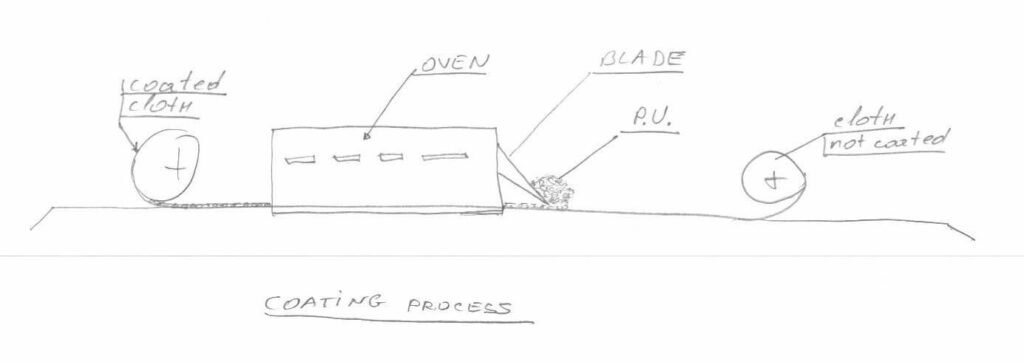
How many coating layers the market offers
Today, no paragliding cloth manufacturer offers cloth with one layer of coating; most make it with two layers. Here opinions are split: some apply two layers of coating to the same surface of the cloth, others apply one layer to each surface. Applying two coated layers to one side is less expensive and faster; in the author’s view, the more expensive alternative is probably also the better one.
One manufacturer used to go even further: they constructed the cloth from a minimum 50 × 50 thread count and then coated it four times – two coats of PU polymer, one to each surface, and then two coats of silicone, one on each surface, to protect the PU surface. They are known for the legendary durability of their cloth, but at a price and with extra weight.
To conclude: more coating polymer and/or more layers of coating end up with better cloth porosity (airtightness). The cloth will be more expensive to produce, heavier and thicker. There are no magic tricks and no short cuts to lighter and better cloth.
Check the declared cloth weight
There is another, very bold way to reduce the weight of the cloth: by declaring 40 grams on the specs instead of 45 grams, the manufacturer reduces the weight of the cloth by 12%, as the article puts it. Since cloth weight is always declared with some tolerance, say 45 g ± 5 g, most manufacturers will put 40 g on cloth weighing 50 g. The recommendation: do not take the manufacturer’s declaration for granted, and check the weight from time to time.
The wet-finger test and ripstop junctions
Anyone who checks the porosity of an ageing glider with the old-fashioned method – pressing a wet finger to the cloth surface to squeeze moisture through – has probably noticed that moisture bubbles first at the cross-sections of the thicker ripstop threads, while the rest of the surface is still airtight. This is because the thin layer of coating does not fully cover the thicker cross-section of the ripstop junctions, and these points give in first.
This leads the author to an open question: maybe plain weave cloth with the same coating would give better porosity results for a longer time.
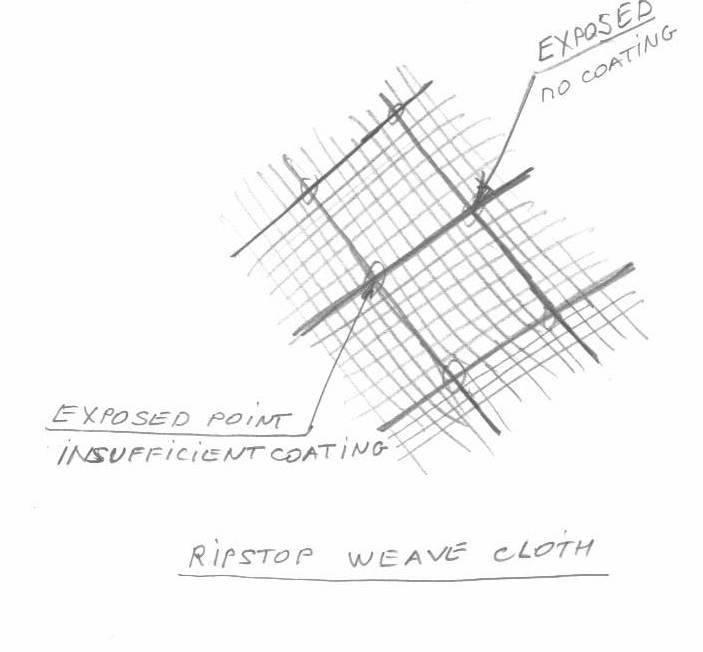
3. Elongation and elasticity
The third parameter is the elasticity of the cloth: its elongation under load in different directions and its ability to recover to the original dimensions when the load is released. Here too there is a host of opinions – rigid or somewhat elastic, crunchy or smooth and silky.
Since all types of paragliding and parachute cloth are made from the same nylon filament, the basic elasticity characteristics of the cloth before calendering, coating and finishing are quite similar. Woven cloth before finishing (grey goods) has quite low elasticity and good recovery on both warp and weft, along and across the cloth.
On the bias – the diagonal 45-degree direction to warp or weft – the cloth is not as stable. Tension on the bias easily changes the dimensions of the cloth construction, and once the load is released the deformed cloth does not recover to its original shape.
What coating does for dimensional stability
This is where coating comes in. The coating bonds the threads together into a frozen-like construction – imagine a thin layer of ice frozen on netting. The ice makes the net rigid in all directions, including the bias, as well as airtight. Properly made coating locks the thread construction so that the threads cannot move relative to each other in the woven cloth.
If the cloth were coated with a material like ice – rigid but brittle – the coating would crack under load in different directions, contributing to deformation of the cloth and increased air permeability. A certain degree of elasticity in the coating material is therefore desirable to prevent cracking, known as white breaks: white lines appearing on the cloth that mark the cracked edges of the coating.
The desirable feature is a coating that stretches under load as little as possible without cracking and then regains its original shape when the load is off. A proper blend of minimal elasticity and good recovery characteristics guarantees the long-term performance of the fabric. The quality of the coating is paramount to ensure the performance of the cloth over time.
Which cloth for external surfaces, which for ribs?
It is generally accepted that medium-soft cloth with a crunchy feel, a certain degree of elasticity and good recovery is best for external surfaces.
For ribs, opinions are split. One school of thought believes the cloth should be as rigid as possible, with no stretch whatsoever. Other manufacturers use the same cloth for ribs and external surfaces. At first sight rigid cloth seems logical for ribs, because whatever shape is designed, cut and sewn into the profile should stay the same.
The problem is that all the different types of rigid cloth have quite bad recovery characteristics. They tend to distort quickly under excessive load and do not regain their original shape. The process is accelerated because the cloth is crushed, crumpled, fluttered and shaken when the glider is used, generating an endless number of small coating cracks, so the wing is flown on a profile that becomes more and more different from the designed one.
Profile, trim and lifespan
Another argument against rigid cloth is that the designed rib profile is known and defined only where the rib is stitched between the panels. Any other cross-section of the wing reveals a profile quite different from the projected one, because it results from inflated surfaces with a variable cross-section across the span.
The designer controls only the profile stitched into the actual rib, and the performance of the glider in general is the result of empirical trim by the design team – an entirely trial-and-error process without any analytic base. Under these circumstances it is more important to preserve the optimal performance of the glider as trimmed over the lifespan of the wing than to live under the illusion that rigid cloth brings theoretical design and reality closer, while ignoring the accelerated ageing of rib and external-surface cloth.
The author’s conclusion: against rigid cloth, unless it remains rigid without plastic deformation for as long as the glider is used. The preferable cloth for rib construction is the cloth with the best recovery characteristics that does not deteriorate or deform over the lifespan of the product.
Technical data per manufacturer documentation from APCO Aviation Ltd , as of 2026-09-22.