
Survivability, not just a soft landing
UAV recovery is usually treated as a descent problem. But reaching the ground is only part of the recovery outcome.
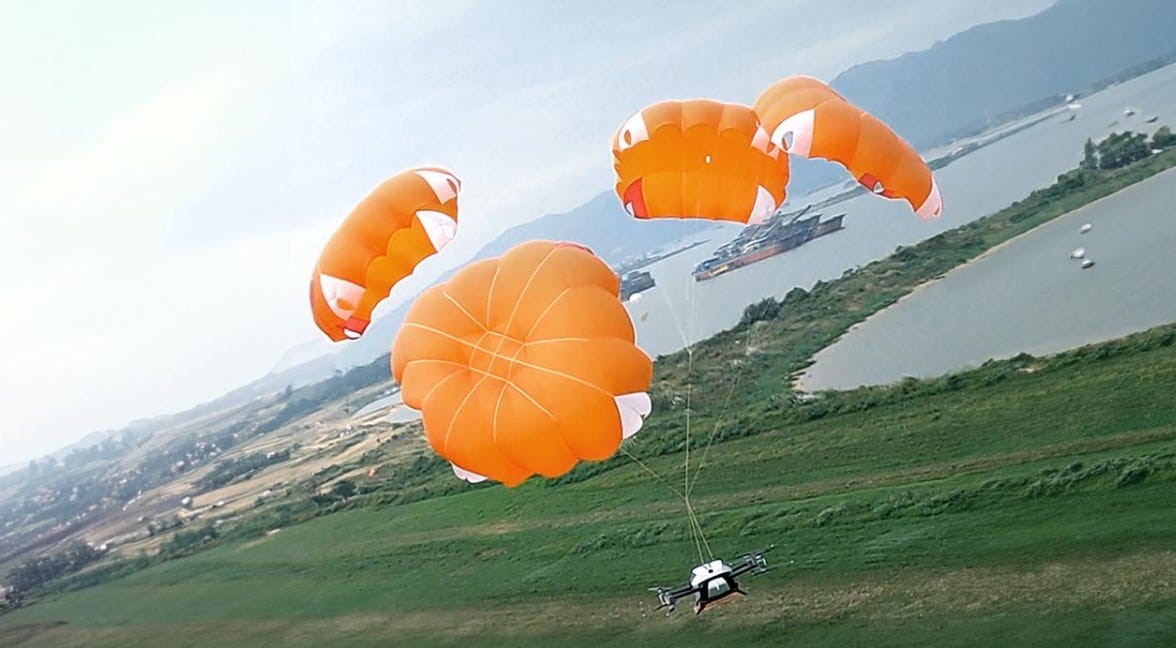
The actual question
Published 14 July 2026.
UAV recovery is usually approached as a descent problem: how to deploy the recovery system, slow the platform and bring it to the ground. The wider question is whether the UAV, payload, electronics, structure and mission-critical systems can survive the complete return in the condition required for inspection, reuse, repair, analysis or continued operation.
For UAV engineering teams and aerospace system integrators, this means recovery performance must be understood across the full return process. Opening shock, descent stability, landing forces, terrain interaction, rollover, dragging and post-landing movement can all affect the condition of the recovered asset.
APCO Aviation Defense develops UAV recovery and defense textile solutions with critical asset preservation and survivability in mind, focusing on the complete return rather than landing alone. The central design question is not only how the UAV comes down, but what must remain protected when it returns.
In short
- UAV recovery performance includes deployment, descent, landing and post-landing conditions.
- Survivability defines what must remain intact, usable, repairable or available for analysis after recovery.
- Opening loads, stability, impact forces, terrain and post-landing movement can affect the returned asset.
- Recovery-system decisions should reflect the limits of the platform, payload and mission-critical systems.
- A successful recovery outcome begins with a clear definition of what must return and the condition required.
What survivability means
Survivability is the ability of the platform and its critical systems to withstand the complete return process and arrive in the condition required by the mission or project. That condition is not the same for every UAV: one platform must return ready for reuse, another only needs to remain repairable, and in a development or test programme the priority may be preserving structure, electronics, recorded data or the test article for inspection and analysis. It may apply to:
- The UAV structure and the mission payload.
- Sensors and electronics.
- Payload mounting points.
- Power and communication systems.
- Recorded mission or test data.
- Other mission-critical components.
A practical measure of recovery success
The recovery requirement should identify which elements carry the greatest mission or project value and define the condition in which they must return. This gives engineering teams a practical measure of recovery success that reflects the purpose of the platform and its payload.
Why survivability matters to engineering teams
UAV engineering teams must integrate recovery into a platform with limited weight, volume, geometry, structural capacity and aerodynamic flexibility. They also carry responsibility for the value already invested in the UAV, payload, electronics, testing and mission.
The real need is therefore to align recovery performance with the condition required from the returned asset. Considering survivability from the beginning helps teams:
- Identify the most critical asset.
- Define acceptable load and damage limits.
- Account for payload sensitivity.
- Evaluate realistic landing conditions.
- Reduce late integration changes.
- Align recovery decisions with mission and project needs.
- Preserve assets required for reuse, repair, inspection or analysis.
Why descent alone falls short
Deployment and descent are essential parts of UAV recovery. The system must activate correctly, slow the platform within the available conditions, provide suitable stability and support the intended return path. But these measures do not describe the complete recovery outcome.
A system may hit its target descent rate while payload, mounting structure or internal electronics still see unacceptable loads. A UAV may complete controlled descent and still return with structural damage, a damaged payload or sensor, failed mounting points, shock-damaged electronics, broken landing components, inaccessible mission or test data or secondary damage after touchdown. When descent becomes the main measure, the system may be evaluated without fully accounting for the asset’s final condition.
Survivability closes that gap by connecting recovery-system performance to the physical condition and continued value of the platform, payload and mission-critical systems.
Where the risk builds: deployment loads
Survivability risk develops throughout the recovery process; different forces, movements and operational conditions affect the UAV at each stage. Deployment creates a rapid transition from flight to deceleration. The resulting loads may be transferred through:
- Recovery attachment points.
- The UAV structure.
- Payload mounts.
- Internal electronics.
- Structural interfaces.
Controlling opening shock
Opening-shock control can therefore influence both deployment behaviour and the condition of the platform and payload after activation. The relevant requirement is whether the complete system can remain within its defined load limits during deployment.
Descent stability
Descent rate is one part of the return. Oscillation, rotation, wind drift and platform orientation can also affect the conditions at touchdown. Descent stability may influence:
- Horizontal landing speed.
- First ground contact.
- The distribution of impact forces.
- The likelihood of rollover.
- Interaction with terrain.
- Post-landing movement.
Landing forces
The recovery approach should therefore support the landing conditions required by the platform and payload. At touchdown, the remaining vertical and horizontal energy is transferred into the platform, payload, terrain or impact-mitigation components. The outcome can be affected by:
- Platform mass.
- Descent rate.
- Horizontal movement.
- Landing orientation.
- Platform geometry.
- Payload position.
- Structural limits.
- Surface conditions.
Airframe limits are not sensor limits
An impact that remains within the limits of the airframe may still exceed the limits of a sensitive sensor, electronics package or mounting structure.
Terrain interaction
Landing terrain changes how impact energy is transferred and how the platform behaves after contact. Prepared ground, hard surfaces, rocky areas, slopes, forested terrain, mud and uneven ground can create very different recovery outcomes. Terrain may affect:
- Initial impact.
- Platform orientation.
- Rollover.
- Bouncing.
- Dragging.
- Contact with nearby objects.
- Accessibility for retrieval.
Terrain belongs in the requirement
Expected terrain should therefore be part of the recovery requirement rather than an assumption made after the system has been selected.
Post-landing movement
The UAV may continue moving after its first contact with the ground. Wind acting on the canopy may pull the platform; the UAV may bounce, roll, tip over, drag or strike nearby objects. This movement can damage a platform or payload after the primary descent and landing requirements have already been met. Post-landing behaviour should be considered when it could affect the required condition of the recovered asset.
How survivability changes system decisions: permitted opening loads
Once survivability is defined as a recovery requirement, it begins to influence the technical direction of the system. Engineering teams need to understand what loads the structure, attachment points, payload mounts and internal systems can tolerate. Those limits may affect:
- Deployment timing.
- Canopy selection.
- Opening sequence.
- Opening-shock control.
- Structural interfaces.
Balancing descent rate and stability
The selected recovery approach should remain compatible with both the available deployment conditions and the limits of the protected asset. The recovery system must provide the required descent performance while supporting suitable stability and landing orientation. A lower vertical descent rate may not provide the required outcome if excessive horizontal movement, oscillation or rotation creates unacceptable landing conditions. Descent performance should therefore be evaluated as part of the complete landing event.
Is impact mitigation required?
Some platforms or payloads may require additional protection at touchdown. Depending on the project, the recovery solution may include:
- Airbags.
- Deceleration mechanisms.
- Energy-absorbing components.
- Other textile-based impact-protection elements.
How protection is chosen
The need for these components should be based on expected landing forces, terrain, payload sensitivity, integration limits and required return condition.
The expected operating environment can also change the recovery-system direction. A system developed for prepared ground may not provide the same outcome on rocky, sloped, forested or uneven terrain. Terrain planning may affect descent behaviour, landing orientation, impact mitigation and control of post-landing movement.
Managing integration trade-offs
Recovery components must fit within the UAV’s available:
- Weight.
- Packing volume.
- Geometry.
- Structural interfaces.
- Aerodynamic limits.
- Deployment envelope.
Selecting within real constraints
The aim is not to add every possible protection component. The aim is to select and integrate the elements needed to support the survivability requirement within the platform’s real constraints.
Questions to define before recovery design
A survivability-focused recovery requirement begins with clear questions. They connect the recovery system to the real platform, payload, operating environment and required outcome.
| Question | What to define |
|---|---|
| What carries the greatest value? | Is the critical asset the complete UAV, a sensor or electronics package, a mission-specific payload, recorded data, a test article or a structural component required for analysis? The answer determines what the recovery system must protect most closely. |
| What condition is required after recovery? | Must the asset be immediately reusable, repairable, available for inspection, suitable for failure analysis, capable of preserving stored data or protected from a defined level of damage? The required condition should be stated clearly enough to guide design and testing. |
| What loads can the system tolerate? | The engineering team should define relevant limits for opening shock, structural loading, payload mounting, electronics, landing impact, horizontal movement and post-landing events. |
| Where is the system expected to land? | Expected terrain and environmental conditions should be included in the recovery requirement. A system intended for prepared ground may require a different solution from one expected to return over hard, rocky, sloped, forested or uneven terrain. |
| What are the integration limits? | Available space, weight, structural interfaces, deployment conditions and aerodynamic constraints determine which recovery directions are practical. |
Five common misconceptions
Several assumptions about UAV recovery and survivability distort the outcome:
- “A successful deployment means the recovery succeeded.” Deployment confirms that one stage of the recovery process occurred. The condition of the UAV and payload still depends on descent behaviour, landing, terrain interaction and post-landing movement.
- “A low descent rate guarantees a safe return.” Descent rate affects landing energy, but horizontal movement, orientation, terrain, payload sensitivity and secondary impact can also influence the outcome.
- “Protecting the airframe protects the full system.” The payload, sensors, electronics or stored data may have different limits and may carry more mission value than the airframe.
- “Survivability can be addressed after selecting the recovery system.” Survivability requirements may affect system size, weight, deployment timing, structural interfaces and landing protection. Defining them late can reduce the practical design options.
- “Recovery ends when the UAV reaches the ground.” Rollover, dragging, bouncing, wind, terrain and environmental exposure may continue to affect the asset after touchdown.
What good survivability-focused recovery looks like
A good recovery outcome begins with a clear definition of the critical asset and the condition in which it must return. The engineering team should be able to confirm that:
- the protected asset has been identified,
- its sensitivity and permitted loads are understood,
- deployment conditions remain within defined limits,
- descent behaviour supports the intended landing conditions,
- terrain has been included in the recovery requirement,
- landing forces are compatible with the platform and payload,
- post-landing movement has been considered where relevant,
- recovery components fit the platform’s integration limits,
- the system can be evaluated against a clear return requirement.
A basis for design, testing and validation
This gives the team a practical basis for design, testing and validation.
APCO Aviation Defense develops UAV recovery and defense textile solutions with the complete return in mind, not only landing. Its recovery work considers the platform, payload, electronics, structural limits, deployment conditions, landing environment and the condition in which the critical asset must return. APCO applies experience in UAV recovery, parachute systems, opening-shock control, impact mitigation and platform-specific integration to help teams develop a solution around the real survivability requirements of the project — where the recovery system must help bring back what matters.
- Applies to
- Fixed-wing UAVVTOL recoveryMulti-rotor
- Environments
- Rough terrainAmphibious recovery
Technical data per manufacturer documentation from APCO Aviation Ltd , as of 2026-09-22.