
JPADS
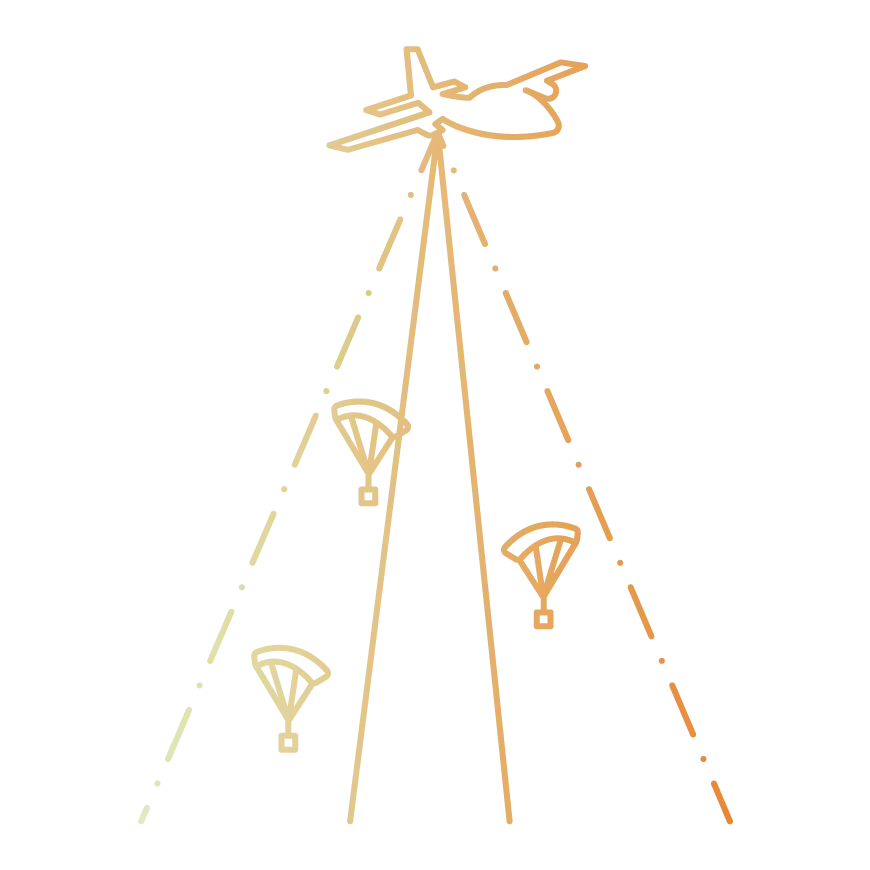
In a Joint Precision Aerial Delivery System the canopy sets the stand-off range: the better the glide, the further the aircraft can stay away.
Precision, range, reliability
The parafoil solutions for JPADS draw on more than 50 years of aerodynamic innovation in paragliders and paramotor wings. They are designed to meet the most demanding military and humanitarian mission requirements.
Why parafoils are preferred
A parafoil offers the best glide performance available and enables stand-off drops from greater distances — less aircraft exposure, high accuracy on the designated coordinates. Compared to alternatives such as Rogallo-style guided parachutes or modified round and square canopies it provides:
- Higher glide ratio (L/D) — for extended reach and improved safety margins.
- Better headwind penetration — essential for precision in adverse weather.
- Full flare and manoeuvrability — for controlled landings and reduced impact forces.
Aerodynamic design
Three features shape the canopy geometry:
- High glide ratios exceeding standard JPADS specifications.
- Optimised aspect ratios balancing lift, stability and manoeuvrability.
- Advanced airfoil profiles refined through decades of real-world flight testing.
Canopy and guidance have to match
The systems are compatible with autonomous GPS/INS guidance; line layout, riser configuration and control surfaces are matched to the specific hardware. For integration into constrained payload bays or multi-role UAVs come ultra-light fabrics down to 10 g/m² and compact packing, which cuts system mass substantially.
What underwrites the design
Wind tunnel and CFD simulation optimise canopy geometry, field trials verify it under high-altitude, high-wind and variable-load scenarios. Materials are low-porosity, high-tensile fabrics for repeatable performance over multiple deployments, produced in ISO 9001-certified processes with full material and process traceability. UV, abrasion and weather resistance provide extended operational life.
Tailored to the mission
Canopy sizes and performance envelopes are tailored to mission-specific needs. The canopies can be integrated into existing JPADS frameworks or supplied as part of a turnkey delivery solution.
Operational benefits
Four effects count in the field:
Parafoils are engineered for both conventional and motored JPADS in the defence and security sectors — for high-value military payloads as well as time-critical humanitarian relief.
- Pinpoint accuracy: reducing cargo recovery time and mission risk.
- Higher survivability: controlled descent rates and flare capability minimise damage.
- Wider mission envelope: operable in challenging weather and wind conditions.
- Extended range and endurance (motored JPADS): significantly increasing operational flexibility.
- Products
- Ram-air parachutesCargo parachutesRelease mechanisms
- Environments
- Low air densityRough terrain
Technical data per manufacturer documentation from APCO Aviation Ltd , as of 2026-07-30.