
Cargo delivery · non-guided
Non-guided cargo parachutes are typically designed for one-time use — which makes cost-effectiveness a design goal, not a side effect.

Round, square or cluster
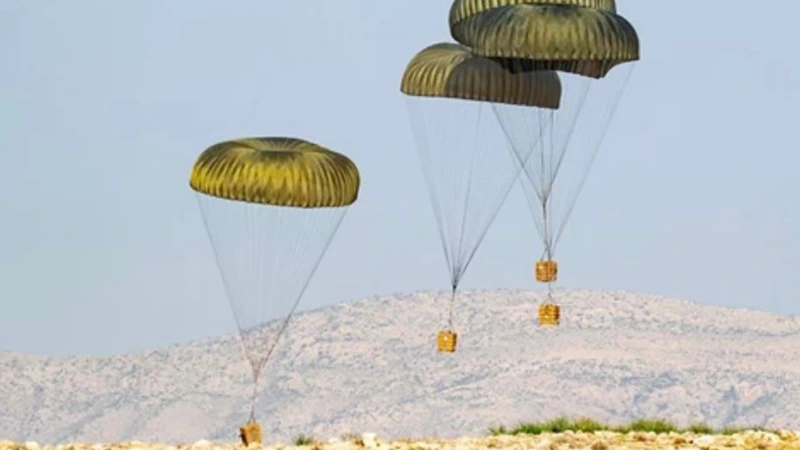
For payloads exceeding 500 kg round canopies are the rule: simpler to manufacture, inherently stronger and highly reliable in high-load scenarios. For lighter cargo, square canopies deliver a slower descent rate and improved pendulum stability, at higher production cost. Clusters — round, square or a combination — are the cost-efficient route using multiple smaller commercially available canopies; their number tunes descent rate to payload weight and sensitivity.
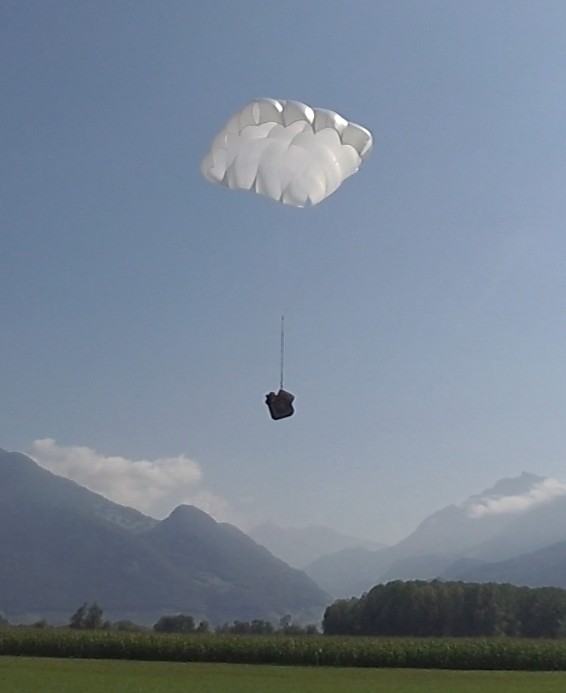
After landing
Most cargo delivery systems incorporate a release mechanism. It disconnects the canopy immediately after touchdown so wind cannot drag or flip the load — protecting both cargo and parachute.
Operational scenarios
The range is wide:
- Military resupply: ammunition, rations, fuel or medical supplies to forward operating bases without prolonged aircraft exposure.
- Humanitarian aid drops: food, water, shelter and medical kits to disaster-stricken or remote areas without ground access.
- UAV and equipment recovery after mission completion.
- Expedition and remote logistics for science, mining or offshore platforms.
- Products
- Cargo parachutesDeceleration parachutesRelease mechanismsGround landing crash pads
- Environments
- Rough terrainAmphibious recovery
Technical data per manufacturer documentation from APCO Aviation Ltd , as of 2026-07-30.