
Testing and validation
Before committing further time, budget and resources, you need evidence that the solution performs as intended.
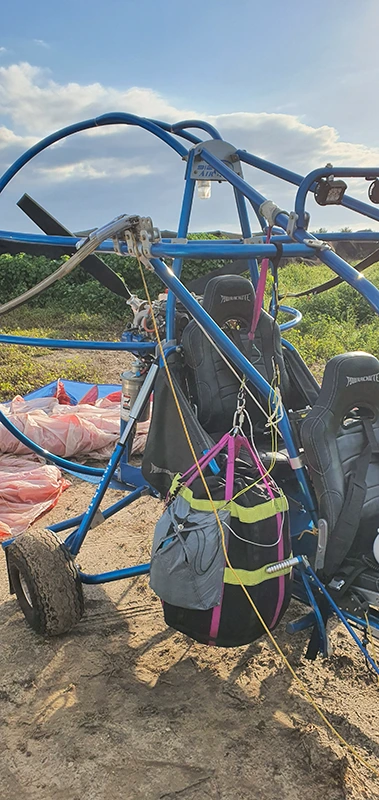
Testing starts with the question
Testing and validation provide that evidence by evaluating the prototype against its required function, operating conditions and integration limits. This shows what works, what requires refinement and whether the solution is ready to move forward.
First comes the question the prototype must answer: controlled recovery, deployment behaviour, impact protection, containment, capture, flotation, platform integration or another defined function. Defined up front are the required outcome, the relevant operating conditions, the prototype configuration, the test scenario, the system behaviour to be observed and the criteria that will guide the technical decision.
The whole system is assessed
The prototype is evaluated as a complete physical system. Depending on the project that covers:
- Textile materials and construction.
- Packaging, folding and storage configuration.
- Attachment points and interfaces.
- Deployment sequence and timing.
- Expected loads and physical stresses.
- Platform, weight and volume limits.
- Material and structural behaviour.
- Handling and operational requirements.

What the result means
The findings either confirm that the selected direction performs as required, or identify changes to materials, configuration, dimensions, packing, deployment arrangement, attachment points or platform integration. Not every first prototype should move directly into production. Testing provides the information needed to refine the solution before greater resources are committed.
Where formal acceptance or certification may later be required, the evaluation can also help identify the technical evidence and further assessment needed. Applicable standards, approvals and certification processes remain defined by the project and relevant authority.
What your team receives
Your team receives documented evidence that supports the next project decision — a clearer technical direction grounded in observed prototype behaviour rather than assumptions. Depending on the testing scope, this can include:
- Defined test objectives.
- Agreed evaluation criteria.
- Documented observations and findings.
- Identified technical or integration changes.
- A clearer understanding of prototype performance.
- Recommendations for further development.
- Identification of additional testing needs.
- Supporting information for formal assessment where applicable.
- A practical basis for production planning.
Why APCO
Testing a textile solution requires an understanding of how materials, construction, loads, deployment and platform integration affect its performance.
The manufacturer develops defense textile solutions for recovery and protection across defense, aerospace and unmanned systems. Its experience includes UAV recovery systems, parachutes, airbags, deceleration mechanisms, deployment systems, ballistic and capture nets, precision airdrop systems and custom textile-based applications. Because it works across requirements, prototype development, testing and production, evaluation findings remain connected to the wider development and manufacturing process. A 3,200 m² production facility supports the practical connection between prototype refinement and future production requirements.
- Phase
- Testing
- Standards
- ISO / ASEN standards
Technical data per manufacturer documentation from APCO Aviation Ltd , as of 2026-07-30.