
VTOL recovery
VTOL platforms demand extremely fast deployment and rapid stabilisation — at both ends of the flight envelope.
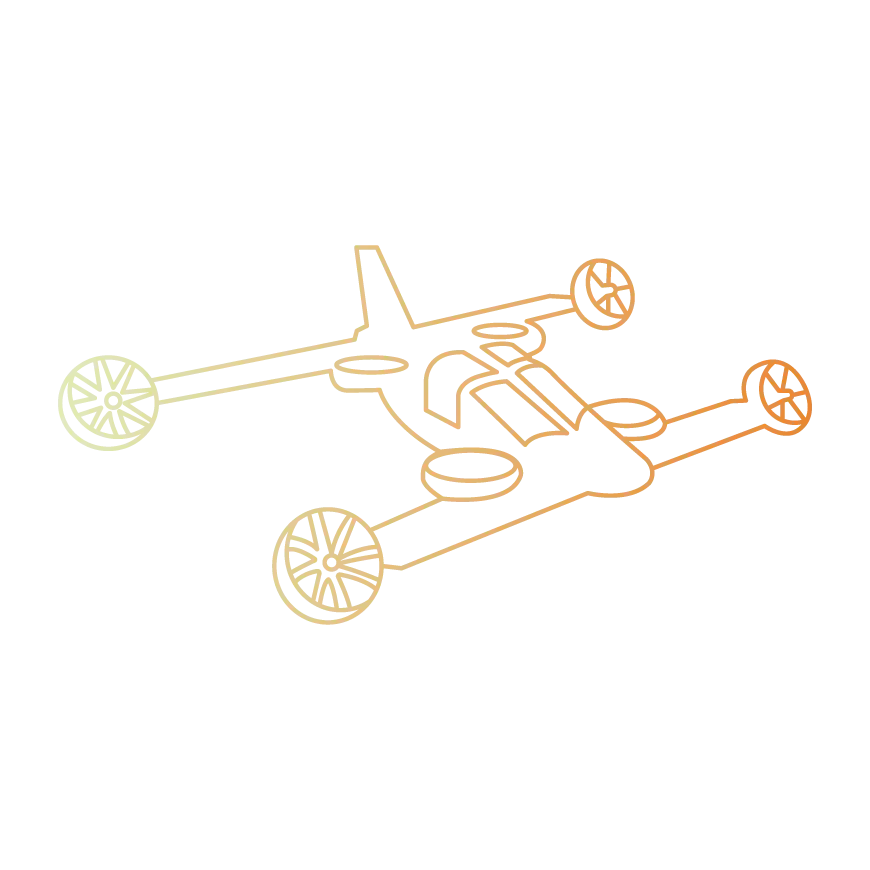
From UAV to air taxi
The emergency parachute systems for VTOL platforms are built to perform at both ends of the flight envelope — whether the mission involves a military UAV, unmanned helicopter, electric air taxi or next-generation human-carrying VTOL.
Hover is the special case
Hovering is unique to VTOL flight: a low- to zero-airspeed environment. If something fails during take-off or landing, there is little to no altitude margin. The design therefore has to deploy and inflate the canopy in the shortest possible time, even in dead air — every metre of height loss counts.
And the opposite of it
At maximum forward speed the same canopy must absorb extreme opening shock without structural damage. That calls for reinforced materials, precision-engineered lines and military-grade construction. To cover both, VTOL recovery systems are typically integrated with pyrotechnic or mechanical ejection mechanisms that forcefully extract the parachute and accelerate inflation.
Manned VTOL and air taxis
Urban Air Mobility platforms and manned VTOL aircraft are held to different standards than UAVs. International certification standards such as EASA SC-VTOL-01 in Europe and the FAA powered-lift regulations emphasise controlled emergency landing over uncontrolled descent. Passenger-carrying platforms therefore favour steerable or guided systems, enabling pilots to navigate away from obstacles and achieve a safe landing zone; non-steerable ballistic systems may be inadequate for that certification.
Designing for manned VTOL scenarios
Designing for manned VTOL involves:
- Controlled descent capability to comply with Enhanced Category safety requirements for operations over populated areas.
- Extremely fast deployment at low altitude — critical in air taxi routes where flights often occur near urban structures.
- Shock-resistant construction to withstand the high opening loads from rapid inflation in both hover and forward flight.
- Regulatory alignment with both EASA and FAA frameworks to support type certification and operational approval.
Fields of use
Whether a VTOL platform is designed for defence, emergency response or commercial passenger transport, what it needs are lightweight, low-bulk, high-reliability recovery solutions that meet the most demanding operational and certification requirements.
- Products
- VTOL recovery parachutesRam-air parachutesUAV airbagsRelease mechanisms
- Environments
- Rough terrainLow air density
Technical data per manufacturer documentation from APCO Aviation Ltd , as of 2026-07-30.