
Fire and heat resistance
For platforms exposed to flame, hot gases, engine exhaust, pyrotechnics or radiant heat, the entire recovery system is engineered thermally.

Defense textile solutions for high-temperature recovery
APCO Aviation Defense specializes in lightweight, low-bulk recovery textile solutions for UAVs, aerospace platforms and other mission-critical applications. For platforms exposed to flame, hot gases, engine exhaust, pyrotechnics or radiant heat, APCO develops fire- and heat-resistant recovery systems for UAVs, drones, missiles, aircraft and other mission-critical platforms.

Heat changes the system, not just the material
High-temperature exposure affects more than material selection. It can change how the system opens, how loads move through the structure, how seams perform and how the system behaves after folding, vibration or repeated packing. Where materials such as Kevlar are required, the system must be engineered around their lower elasticity and sensitivity to bending.
What the design covers
The full thermal and mechanical environment is considered: canopy, lines, seams, deployment bag, risers and attachment points. From that follow:
- Fire- and heat-resistant parachutes for UAV and aerospace platforms.
- Heat-resistant deployment bags, bridles and risers.
- Kevlar-based canopies, lines, tapes and seams.
- Hybrid systems using Kevlar, Nomex, fibreglass, coated fabrics or protective layers.
- Opening-shock control, reefing and staged deployment.
- Inspection, packing and replacement requirements.
No standard package: materials selected for the mission
There is no single material package for every high-temperature application. The right solution depends on the thermal environment, deployment method, structural loads and operational requirements. APCO selects from materials including Kevlar, Nomex®, fiberglass, coated fabrics and protective thermal layers to balance heat resistance, strength, weight, durability and deployment reliability.
The goal is not only to resist heat. It is to preserve reliable deployment, protect the payload and reduce stress on the platform.
Integration into the recovery system
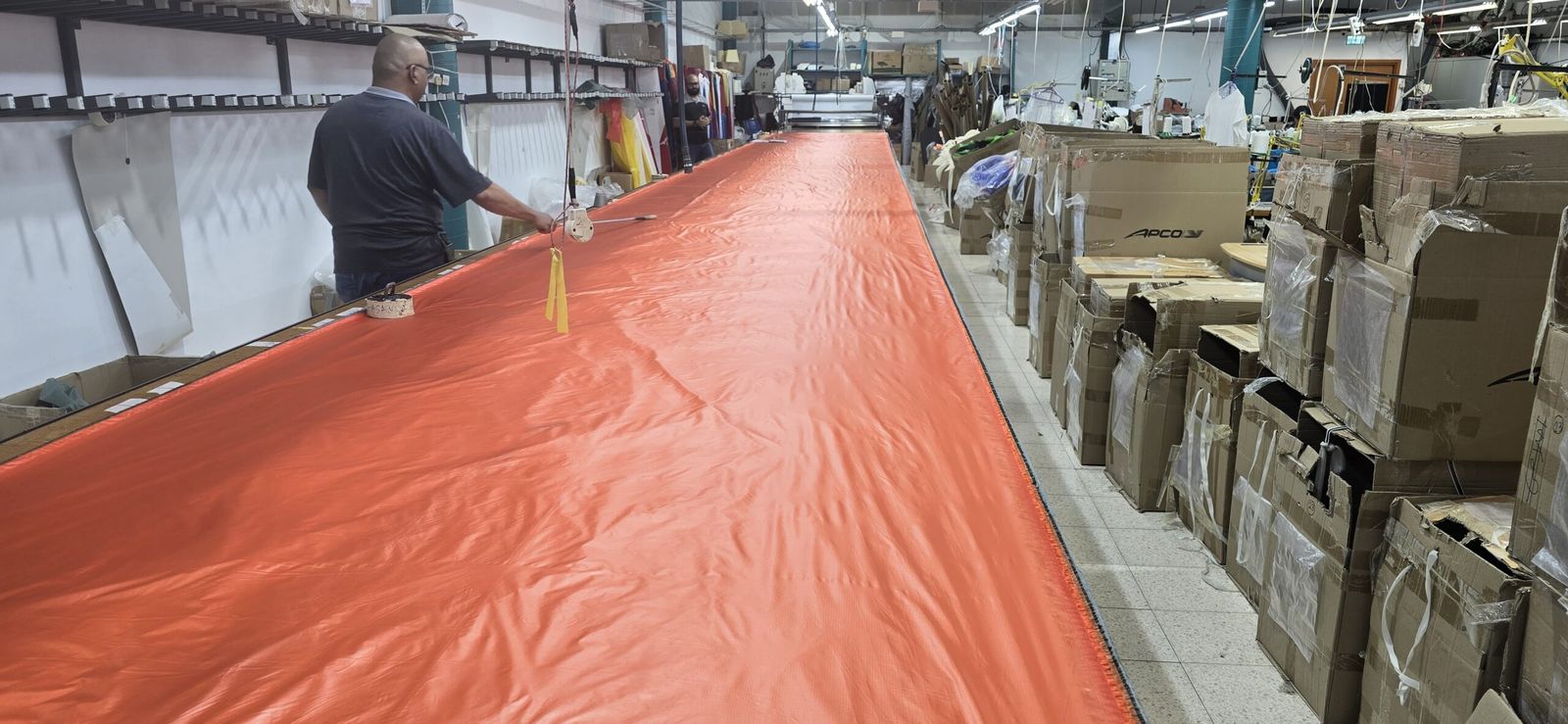
Fire-resistant materials cannot simply replace conventional fabrics. Kevlar and other high-temperature textiles have different mechanical properties that affect flexibility, packing, deployment and load distribution. Every component — including the canopy, suspension lines, seams, deployment bag, risers and attachment points — must work together as one integrated recovery system.
Understanding the thermal environment
Heat affects more than the parachute fabric. Exposure temperature, duration, flame contact, engine exhaust, pyrotechnics and radiant heat all influence how the recovery system should be designed. Understanding the complete thermal environment allows the system to be engineered for reliable deployment while protecting both the payload and the platform.
From requirement definition to production
Successful recovery systems begin with a clear understanding of the platform, its operating environment and the challenges it must overcome. Your team provides platform and operational expertise. APCO Aviation Defense contributes recovery-system engineering, high-temperature textile expertise and system integration experience. Together, both teams define, develop, validate and prepare the recovery system for production:
- Defining requirements: we review temperature, exposure time, flame contact, radiant heat, exhaust, pyrotechnics and post-impact fire risk.
- Review requirements: we assess payload weight, speed, available space, attachment points, deployment method and required descent behaviour.
- Select the system: we define the right materials, load paths, seams, deployment components and thermal protection.
- Prototype and validate: testing may include tensile, seam, heat, fatigue, vibration, deployment and full-system recovery testing.
- Production: following validation, APCO can support documentation, manufacturing and production.
- Manufacturing training: the knowledge, production files and QA support needed to manufacture recovery and protection systems externally.
- Documentation: clear, usable documentation that keeps the project moving forward.
- Support and lifecycle services: technical support after delivery to resolve system questions and confirm readiness.
Why APCO Aviation Defense
APCO Aviation Defense develops lightweight, low-bulk recovery textile solutions and defense textile solutions for UAVs, aerospace platforms and other mission-critical applications. Every system is engineered around the platform, mission profile, deployment method and operating environment to deliver reliable recovery performance while minimizing weight and integration impact.
Our experience includes parachutes, airbags, deceleration systems, deployment bags, opening-shock control and custom recovery systems for payloads ranging from under 1 kg to more than 1,000 kg. By combining recovery-system engineering with defense textile expertise, APCO develops recovery textile solutions that improve deployment reliability, protect valuable payloads and support mission continuity in demanding operational environments.
More than a material change
Fire and heat resistance should not be treated as a material change alone. The full recovery system must be designed around the expected thermal exposure, deployment loads and operational conditions.
- Products
- Deceleration parachutesRam-air parachutes
- Platforms
- High-velocity decelerationHelicopter & UAV engineering
Technical data per manufacturer documentation from APCO Aviation Ltd , as of 2026-07-30.