
Underwater / high-density fluids
Parachutes, drogues and flexible drag devices also operate in media other than air — where different forces apply.
Control below the surface
Objects moving through water or other high-density fluids may require controlled deceleration, stabilization, drift reduction or recovery. APCO Aviation Defense develops deployable defense textile solutions that create hydrodynamic drag to control the movement of marine platforms, underwater vehicles, payloads and other critical assets.
When air is no longer the operating medium
In water and other liquids the surrounding medium creates greater resistance and changes how the system opens, transfers loads and behaves after deployment. It may be used as a soft anchor for boats, as an underwater brake for torpedoes or test vehicles, and as a deceleration and stabilisation system for AUVs, UUVs, ROVs, subsea payloads, sensors, buoys and marine equipment. Depending on the application it may function as an underwater parachute, marine drogue, sea anchor or soft braking device.
How control is created
Once deployed, the textile structure opens in the surrounding fluid and creates hydrodynamic drag. This drag can reduce speed, limit drift, stabilise heading, control underwater descent, reduce impact with the seabed or support recovery. Area, geometry, porosity and tether arrangement determine the drag force, opening load and stability.
Not an aerial parachute in water
The system does not work exactly like an aerial parachute. It must be engineered around the density, viscosity and movement of the operating fluid.
Materials for high-density fluids
Material selection depends on the operating fluid, pressure, deployment loads, exposure duration and reuse requirements. Possible constructions may use high-tenacity polyester, nylon, UHMWPE fibres, aramid fibres, coated textiles, mesh structures, ribbon constructions and marine-grade hardware.
The selected construction must balance structural strength, abrasion resistance, corrosion protection, flexibility, packed volume, system weight and hydrodynamic performance. Waterproof fabric is not always required. In some systems, controlled porosity is necessary to manage drag, opening loads and stability.
Integration with the platform
Your team brings the platform, mission and underwater operating requirements. APCO Aviation Defense brings parachute engineering, flexible drag-device design and defense textile expertise. Together, both teams define the attachment interface, available packing space, deployment method, tether arrangement and required system behavior.
Canopy geometry, porosity, bridles, reefing, deployment containers, release mechanisms, flotation, ballast and retrieval elements can then be developed around the platform as one integrated solution.
Designed around the required motion
The development process begins by understanding what is moving, how quickly it is moving and what must happen after deployment. Platform mass, dimensions, deployment velocity, required final speed, stopping distance, operating depth and maximum allowable loads all influence the design.
Buoyancy, ballast, stability, available packing volume and retrieval requirements must also be considered so the system can control movement without creating unacceptable opening loads, oscillation or structural stress.
From requirement definition to production
APCO Aviation Defense supports the complete development process, from the first technical discussion through testing, documentation and production:
- Defining requirements: define the platform, operating fluid, movement and deceleration requirements.
- Concept and design review: review the drag concept, geometry, deployment method and platform integration.
- Prototype development: build the first physical solution for integration and technical evaluation.
- Testing and validation: evaluate deployment, opening loads, stability and hydrodynamic performance.
- Production: prepare the validated solution for controlled and consistent manufacturing.
- Documentation and certification: provide technical files, test records and required project documentation.
- Maintenance planning: define inspection, storage, retrieval, reuse and replacement requirements.
- Support and lifecycle services: support system readiness, technical updates and future adaptations.
Why APCO Aviation Defense
APCO Aviation Defense applies its experience in parachute engineering, flexible drag structures and defense textile solutions to systems operating in water and other high-density fluids. This allows APCO to develop underwater parachutes, marine drogues, soft anchors and hydrodynamic deceleration systems designed around the required movement, drag, opening loads and platform integration. This capability is supported by:
- More than 50 years of aviation manufacturing experience
- Recovery solutions developed for platforms ranging from under 1 kg to more than 1,000 kg
- Experience with parachutes, airbags, deceleration systems and platform-specific deployment solutions
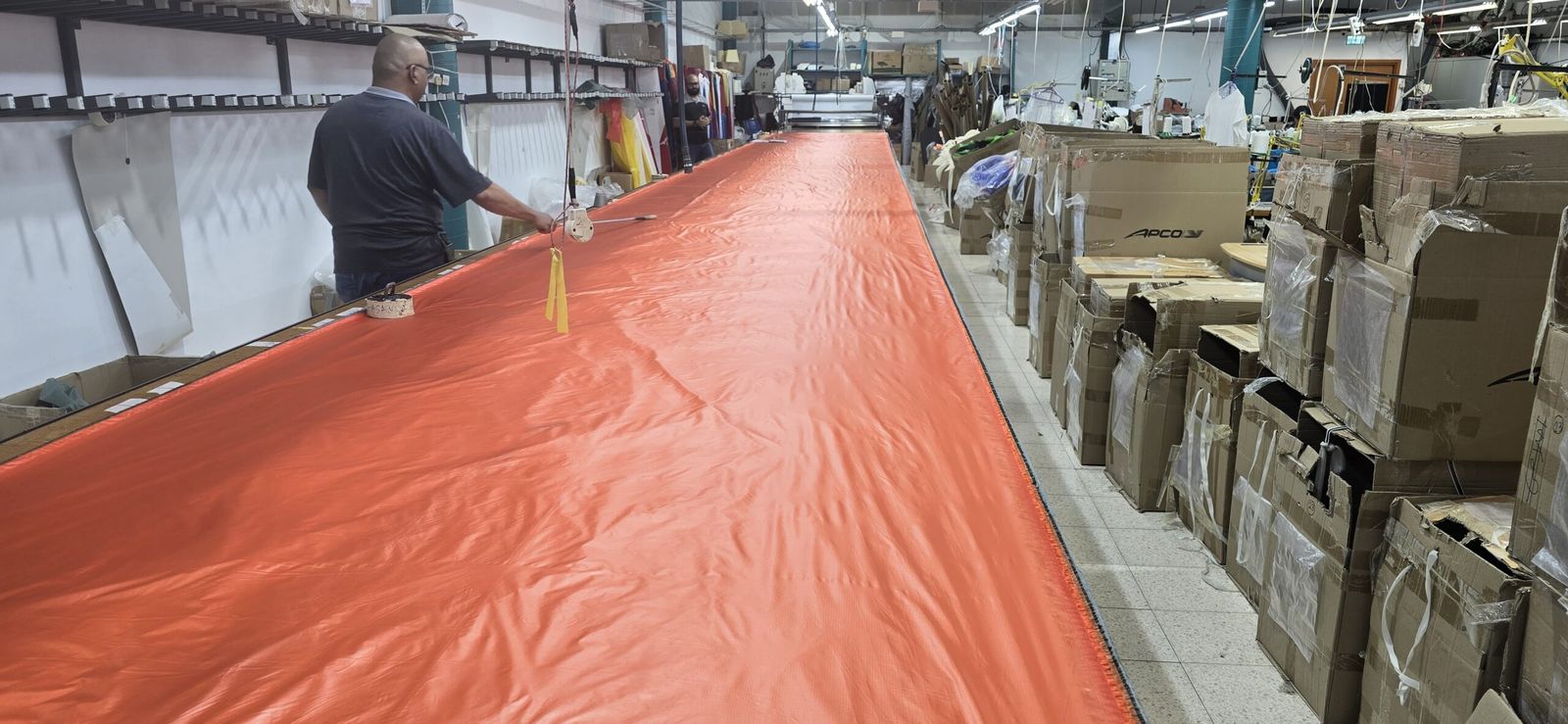
- A dedicated 3,200 m² in-house production facility
- Full-cycle capabilities from requirement definition and design through testing, documentation and production
What we need to know from you
The result is a customized defense textile solution developed to control movement, manage hydrodynamic loads and preserve critical assets in water and other high-density fluid environments.
Tell us what is moving, which fluid it operates in, how quickly it must slow and what loads the platform can withstand. Together, we can define a deployable defense textile solution built around the required drag, stability, deployment and recovery conditions.
- Products
- Deceleration parachutesInflatables & landing pads
- Platforms
- High-velocity decelerationCargo delivery · non-guided
Technical data per manufacturer documentation from APCO Aviation Ltd , as of 2026-07-30.