
H.A.H.O. platforms
High Altitude High Opening means the parachute deploys immediately after the payload exits the aircraft — and then glides a long way to the target.
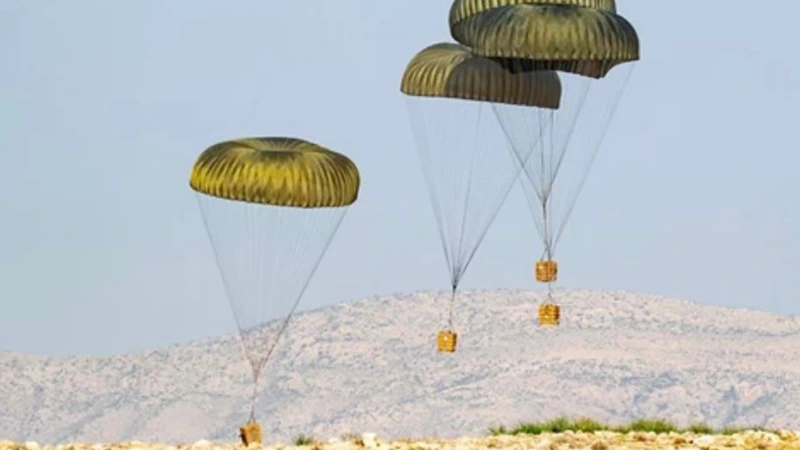
How deployment works
Two methods are common. In static-line deployment the deployment bag is attached to the carrier aircraft, so the parachute opens the moment the payload is released. In drogue chute extraction a drogue deploys instantly upon release and extracts the main deployment bag.
What it delivers in the field
Paired with a guided, steerable parachute — ram-air or parafoil — H.A.H.O. enables precise navigation of the payload to its intended landing coordinates. This is critical for defence operations, humanitarian supply drops and other missions where accuracy is mission-critical. The technique is used in military cargo drops, UAV recovery systems and precision aerial delivery missions.
High altitude calculates differently
Lower barometric pressure at altitude reduces opening shock, which improves equipment and parachute longevity. It does require careful sink-rate calculation based on landing-zone barometric pressure: that pressure directly affects descent speed and therefore touchdown impact.
Custom-designed lightweight, low-bulk textile solutions are engineered to perform reliably in high-altitude environments — for demanding defence applications.
- Products
- Ram-air parachutesGliding parachutesCargo parachutes
- Environments
- Low air density
Technical data per manufacturer documentation from APCO Aviation Ltd , as of 2026-07-30.