
Ground landing crash pads
Crash pads dissipate impact forces at touchdown by deforming in a controlled way — they are energy absorbers, not cushions.

Where they are used
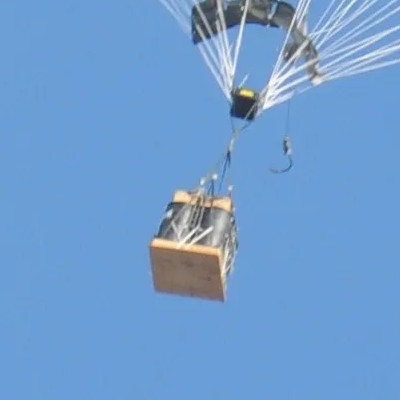
Crash pads, also referred to as impact attenuators, are energy-absorbing systems designed to protect valuable payloads by dissipating impact forces during ground landing. They are essential components in aerospace, defence and UAV recovery operations, particularly for cargo drops or missions with high descent rates.
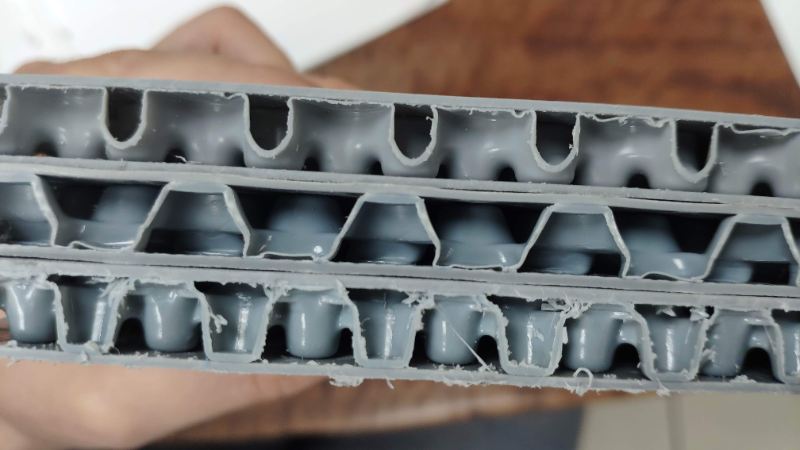
Materials and construction
Typical materials are paper, plastic and aluminium, most often arranged in a honeycomb structure. The principle: a dense array of hollow hexagonal cells deforms progressively under load, converting kinetic energy into a controlled structural collapse that minimises impact on the payload. Such structures are light, very strong in out-of-plane compression and shear resistant — which is why they are common in aircraft and rocket components.
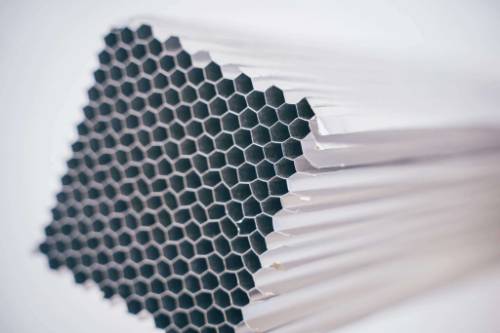
Single or repeated use
Most honeycomb pads are single-use, as they do not recover after absorbing energy. For lighter loads specialised foams are an option; depending on composition and resilience some allow limited reuse. Newer configurations — graded, hierarchical or sandwich-panel — improve energy absorption by optimising how the structure crushes.
When they make sense
Crash pads absorb energy almost entirely in the vertical direction; horizontal forces are dissipated through ground sliding, with or without a pad. They are recommended when descent rates exceed 8 m/s, when the cargo profile demands additional vertical protection, or when landing on unprepared terrain. For maximum effect they are paired with steerable or ram-air systems with flare capability that cut horizontal velocity before touchdown.
In summary, crash pads are generally recommended when:
- descent rates exceed 8 m/s, requiring additional impact attenuation,
- cargo type or mission profile demands enhanced vertical impact protection,
- operational environments involve high-risk landings, such as unprepared terrain,
- integration with steerable or ram-air parachute systems is planned for horizontal speed reduction,
- alternative solutions like airbags are considered but deemed less suitable for the mission. See the UAV airbags page for more details.
- Platforms
- Cargo delivery · non-guidedFixed-wing UAV
- Environments
- Rough terrain
Technical data per manufacturer documentation from APCO Aviation Ltd , as of 2026-07-30.